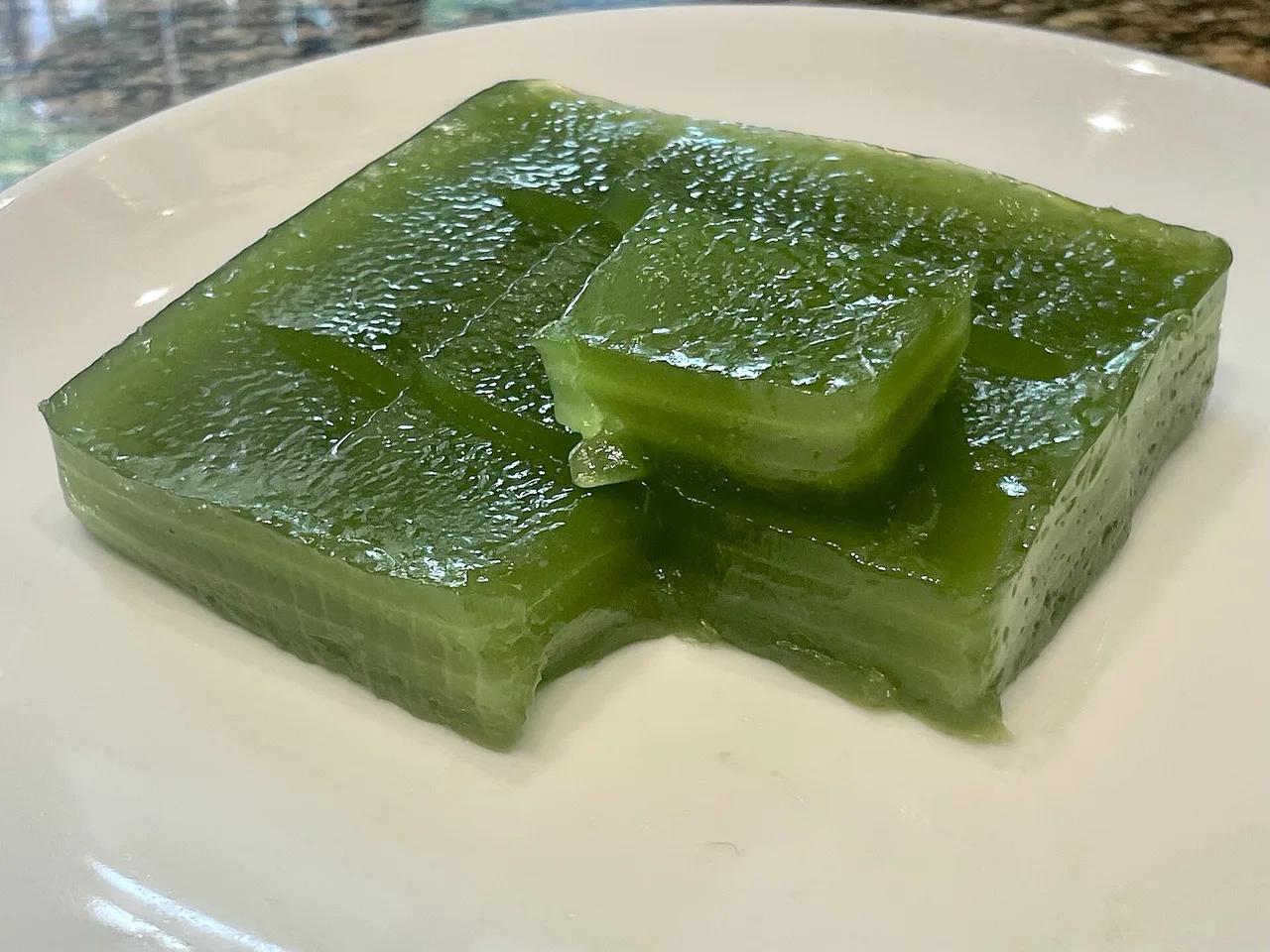
Khanom Chan: Thai Nine-Layer Coconut Dessert Guide
What khanom chan is, why it has nine layers, how it tastes, how it differs from similar desserts, and what to look for at Thai markets and stalls.
On this page
Last updated November 2026: khanom chan (ขนมชั้น) is a steamed Thai dessert made from thin layers of coconut-and-flour batter, usually pandan green and white. The name means "dessert layers", and nine layers is the traditional count. Below we cover texture, the meaning of nine, how to spot it in Thailand, and how it differs from lookalikes. Our Thai dessert guide covers the wider family.
Featured image: Jane and Xuan, CC0, via Wikimedia Commons.
What Is Khanom Chan?
Khanom chan combines two Thai words. ขนม (khanom) means dessert, and ชั้น (chan) means layer. In Thailand you will most often see it cut into green and white squares. Pandan leaf extract gives the green layers their colour and scent.
Its base is tapioca flour, rice flour and coconut milk, with sugar and a pinch of salt. Some cooks add arrowroot flour. Do not confuse it with khanom chin, which is a rice noodle. Wikipedia flags that mix-up, and we agree it is easy to make on a menu.
What Does Khanom Chan Taste and Feel Like?
Expect a fragrant, subtly sweet flavour with a gentle richness from coconut milk. Texture is smooth yet sticky, and chewy in a way that resembles firm jelly. Pandan adds a grassy, floral note.
The word "cake" misleads most first-timers. Khanom chan is not a fluffy sponge. We'd tell newcomers to picture a bouncy, layered jelly that you peel apart as you eat. Skip it if you want something light and crumbly.
Why Nine Layers? Meaning and Occasions
A full serving traditionally has at least nine layers. One common explanation is wordplay. The Thai word for nine, เก้า (kao), sounds like ก้าว, meaning "to step forward". Nine layers therefore stand for progress in life and promotion at work.
A wish for progress turns into real kitchen time, since another recipe ends with 10 minutes for layer nine alone.
That belief explains where the dessert appears. Housewarmings, memorial services for departed family members and weddings all feature it. People say it brings happiness and prosperity to both the maker and the eater. Some Thai regions even use the name khanom chan farh (ขนมชั้นฟ้า) to sound more auspicious. Pink and white versions also turn up at birthdays.
Origins and History of Khanom Chan
Some accounts trace the dessert to the Sukhothai period. Trade with China and India then mixed ingredients and ideas. Its precise origin is unknown, and no single country can claim it.
Another account points to the Dutch colonial era in Indonesia, around the reign of King Rama I. In that telling, local cooks switched from baking to steaming to suit their equipment. A third line of thinking links the dessert to Chinese steamed rice cakes known as jiu ceng gao. Those reached maritime Southeast Asia and picked up coconut milk, pandan and tapioca. Treat all three as stories rather than settled history.
How Khanom Chan Is Made
Cooks dissolve sugar into coconut milk and let it cool. They then whisk it into the flours until the batter is smooth. The batter is split into portions, with one left plain and another tinted green with pandan.
Each layer stays no thicker than 5mm, so a nine-layer tray means many short steaming rounds rather than a single long steam.
Each layer is steamed in a greased mould until set. Only then does the next colour go on. Finished trays cool fully, which firms the dessert so it cuts into clean pieces. One recipe pours each layer no thicker than 5mm.
- Tapioca flour makes the dessert soft, sticky and translucent.
- Arrowroot makes it stickier but less transparent than tapioca.
- Rice flour and mung bean flour give firmness so the layers hold their shape.
- Wipe the steamer lid between layers so water does not drip on the surface.
Khanom Chan vs Similar Desserts
Layered coconut desserts appear across Southeast Asia, and the names blur together. Steamed relatives include Malaysian and Singaporean kuih lapis, Indonesian kue lapis, Vietnamese bánh da lợn and Filipino sapin-sapin. Within Thailand, the neighbours differ more by method than by flavour.
Our crisp coconut pancakes page covers the griddled option. Another page covers crisp Thai crepes. Kue lapis legit is a different dish entirely, because it is a rich baked cake with Dutch-Indonesian roots.
| Dessert | Method | Texture and flavour | Where you'll meet it |
|---|---|---|---|
| Khanom chan (ขนมชั้น) | Steamed layer by layer | Chewy, jelly-like, mildly sweet, pandan-scented | Thai markets, stalls, ceremonies |
| Khanom krok | Cooked on a griddle | Crisp edge, coconut-rich | Thai street stalls |
| Khanom buang | Cooked on a griddle | Crisp, thin shell | Thai street stalls |
| Bua loy | Boiled rice balls | Soft and chewy, served in coconut milk | Thai dessert shops |
| Foi thong | Egg yolk threads set in syrup | Golden, sweet, egg-based | Thai sweets counters |
| Kuih lapis | Steamed | Soft, chewy, pink, green and white layers | Malaysian and Singaporean markets |
| Kue lapis | Steamed | Soft, gelatinous layers | Indonesia |
| Bánh da lợn | Steamed | Layered, popular in southern Vietnam, eaten at Tết | Vietnam |
| Sapin-sapin | Steamed | Chewy, topped with latik | Philippines, especially at Christmas |
How to Spot and Order Khanom Chan in Thailand
Look for green and white squares or diamonds sold cut into pieces. Wikipedia and recipe writers say it is common in markets, shops and restaurants across Thailand. Dessert stalls and ceremonial spreads are the other places to find it. Colours vary, so pink or other tints do not signal a different dish.
One recipe says khanom chan is best on the day it is made. We'd buy from a stall selling it that day, and press a piece with a fingertip if the vendor allows. Prices and hours checked November 2026 are not available for any specific stall, so ask the seller. Expect a small market snack, cheaper than a sit-down dessert.
- Order khanom chan if you want chewy and mildly sweet.
- Choose khanom krok if you want crisp and coconutty.
- Pick rice balls in coconut milk or pandan noodles in coconut milk for something served in a bowl.
- Go for golden egg threads or steamed custard if you want egg-based.
- Mistake one: expecting a soft sponge.
- Mistake two: buying pieces that look dry or hardened at the edges.
- Mistake three: assuming every piece is green and pandan-flavoured.
Making Khanom Chan at Home: Key Decisions
Layer count and steaming time are the main variables. Nine layers is traditional, and one recipe writer says fewer layers is fine. We'd start with fewer if the process feels daunting.
Steaming times differ widely. One recipe gives about 5 minutes per layer. Another adds minutes as layers go up, ending with 10 minutes for layer nine. Follow your chosen recipe rather than mixing the two.
You need a steamer and a mould. Cake pans, aluminium trays and silicone moulds all work. After steaming, cool the dessert completely before cutting. Leftovers keep several days in the fridge, though the texture may turn less chewy.
When the sweet tooth wants more, try mango with sticky rice next. Coconut ice cream with toppings is another easy step. For something hot and pan-fried, there is roti with condensed milk. Chilled water chestnut rubies round out the list.
Frequently Asked Questions
How long does khanom chan last?
One recipe says khanom chan is best on the day it is made. Another says it lasts a few days in the fridge, though the texture may become slightly less chewy. For eating out, buy it from a stall that sells it the same day.
Thai food notes for your next trip
Optional updates to our food guides.
You might also like


Continue reading
More guides you'll find useful